What is Jin Shin?
Jin Shin is a Japanese adaptation of Chinese Acupressure Therapy.
Chinese Acupressure Therapy had a recognizable system documented by roughly 100 BC. Records document Chinese medical texts arriving in Japan in 562 CE.
By 701 CE, Japan had formally incorporated Chinese-derived medical disciplines into its state medical system under the brief reign of Emperor Monmu in the Taihō Era.
Jin Shin's essential method is holding the same points used in acupuncture with each hand, alternating pressure, until their pulses synchronize. This is traditionally believed to indicate that balance and harmony have been restored between those points, thus restoring or improving balance and health throughout the body.
Chinese Medical Theory (CMT) developed over thousands of years from observing recurring relationships between diet, herbs, exercise, meditation, environment, and manual manipulation of the body—and interpreted according to the conceptual tools available to them, including Taoist cosmology, among others.
Over centuries, those interpretations became increasingly systematic medical frameworks—long before anatomy, neurophysiology, connective-tissue science, immunology, and other modern disciplines could investigate the underlying mechanisms.
While their original frameworks—such as qi, meridians, Five Phases, excess/deficiency, etc.—aren't necessary to explain why pressure, touch, movement, interoception, autonomic regulation, connective-tissue loading, or sensory input produces clinically measurable, predictable effects, they still provided a remarkably sophisticated and useful way of understanding our physiology and nature.
Professional practitioners of Chinese Medicine typically take months to learn its highly elaborate systems in order to choose appropriate points to stimulate; and it can take years to master.
However, ARC uses a "Master Sequence" that rebalances the entire body—so you can just follow easy instructions to facilitate the same results without spending tens of thousands of dollars over months or years to get the same benefits.
A brief history of Jin Shin's origins:
In 1912 Japan, Jiro Murai brilliantly synthesized two distinct modalities: applying the gentle, non-invasive, stationary hand-placement of Teate (pronounced "Teh-Ah-Teh") in lieu of acupuncture to the pathways used in Chinese Median Theory; and he eventually called it Jin Shin Jyutsu (JSJ)—which translates to, "The art of the Creator through the person of knowing and compassion."
In that period of intense Japanese nationalism and State Shintoism, Murai anchored JSJ in The Kojiki—Japan's foundational sacred text—as a practical metaphorical framework to make JSJ approachable for the population through The Kojiki's profound cultural authority, and preserve it through political protection.
After falling deathly ill, he isolated himself while experimenting with prolonged, alternating light touch across pairs of acupoints. As he recovered, he discovered this method could promote the deep parasympathetic shift he needed for his profoundly sensitized nervous system to release structural tension in the body's fascia network to restore homeostasis.
Mary Burmeister and Dr. Haruki Kato were the students who passed on Murai's teaching to the US and Japan respectively in the 1950's.
Iona Teeguarden learned JSJ from Burmeister & Kato in the early 1970's, and integrated Reichian theory and other disciplines to develop her own system that she called Jin Shin Do (JSD).
Michael Reed Gach, PhD learned JSD from Teeguarden in the mid-1970's, and taught it as Jin Shin (JS) at his Acupressure Institute in Berkeley, CA, strictly within the Classical and Traditional Chinese Medical systems, instead of the "SEL" points, "flows," and "depths" that Murai passed on through Burmeister.
I completed 1,000 hours at the Acupressure Institute between 1995 and 2000—where my teachers emphasized the interactive relationship of the Body and Mind to achieve the deepest and most complete healing possible.
Later, the word "acupressure" bothered me because "acu" is Latin for needle. Since "needle pressure" is incoherent compared to needle puncture. I was compelled to come up with an appropriate name. Since Burmeister likened the two-handed palpation of distal points in JSJ to "jumper cables," referring to an electrical arc seemed apropos; and I could call those points "ARC points" instead of "acupoints."
ARC also refers to the "arc" of the personal narrative everyone holds and modifies based on the personal unconscious narrative we all generate from our past experiences, present identity, and future hopes.
And, ARC refers to what it actually does: Adaptive Response Conditioning.
By the time I came up with that name, I realized the biomechanics that explain JSJ's phenomena, stripped away its esoteric mythology, and developed the scientific foundation to clinically validate this method in future research—so Western Medicine can finally see why it belongs as an essential part of natural, integrative healthcare. That foundation includes my critical realization that provides a fundamental framework for understanding the biological mechanisms behind Chinese Medicine's foundational concept, Qi. Learn about the Vivome here.
A Modern View
I call this manual method of JSJ Biofeedback-Modulated Stimulation (BMS). This is my original term—that's closely related to Biofeedback-Modulation Electrical Stimulation, which uses electrostimulation instead of manual pressure.
The biofeedback is the blood pressure felt by the fingertips of the provider, and the pressure detected by the mechanoreceptors in the skin, blood vessels, fascia, muscles, tendons, joint capsular tissues, and bones of the recipient.
Blood pressure and mechanoreceptors in both bodies adapt to this interaction as the provider modulates pressure to "chase" the pulses until they synchronize.
The mechanical pressure changes the elastic weave of fascia which has piezoelectric properties and generates energy as the matrix tension changes (like a rubber band).
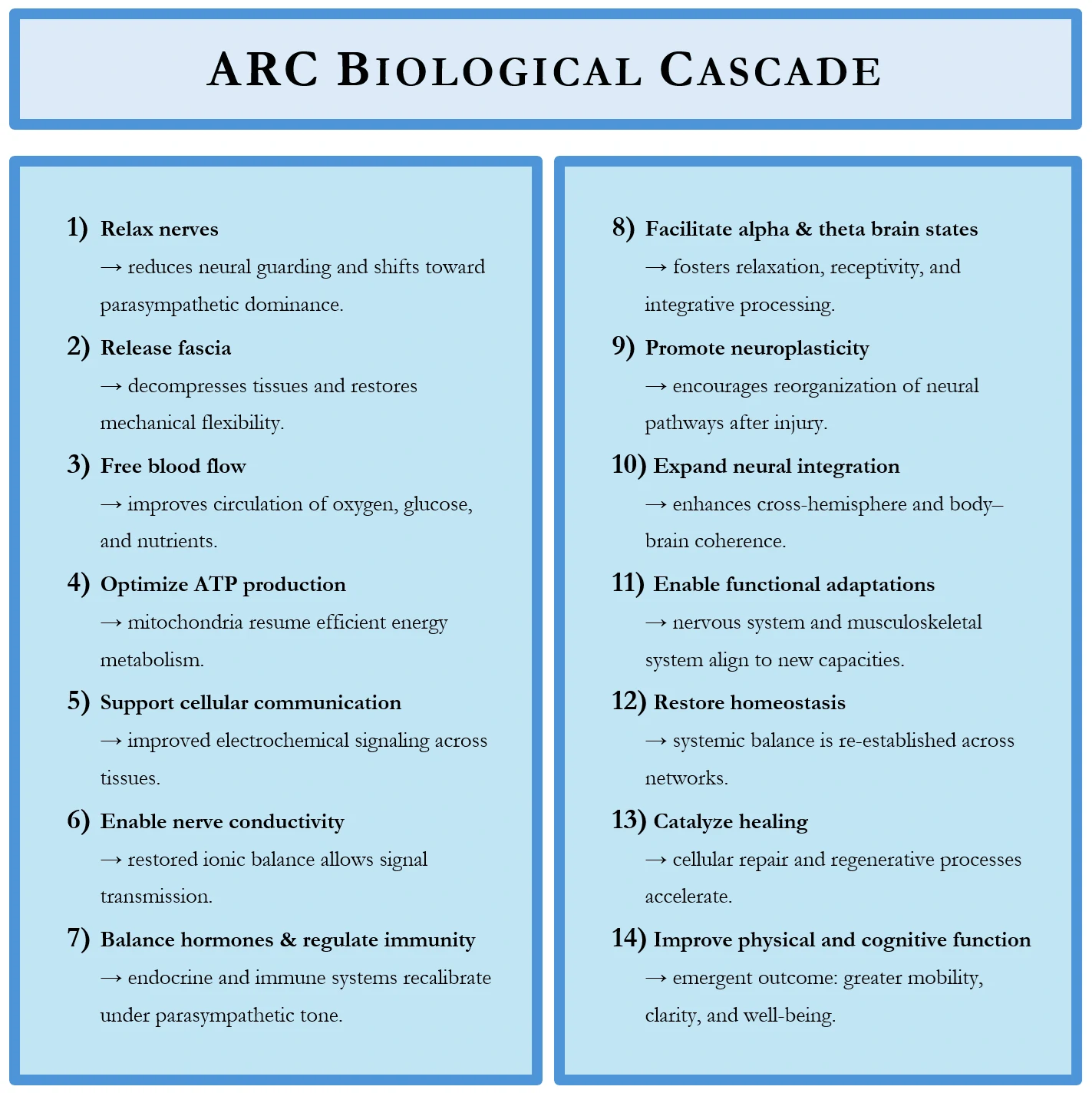
Inducing the parasympathetic response relaxes the nerves and fascia, which releases pressure on blood vessels and nerves, allowing cells to get oxygen and nutrients to support ATP production in the mitochondria—supplying the energy the body needs to restore homeostasis.
This process promotes neuroplasticity—which helps the brain process more information in more brain regions to improve cognitive and adaptive functions, problem-solving, decision-making, creativity, and insights that help us in every facet of our lives. The image below outlines my proposed mechanisms of action:
The biofeedback is the blood pressure felt by the fingertips of the provider, and the pressure detected by the mechanoreceptors in the skin, blood vessels, fascia, muscles, tendons, joint capsular tissues, and bones of the recipient.
Blood pressure and mechanoreceptors in both bodies adapt to this interaction as the provider modulates pressure to "chase" the pulses until they synchronize.
The mechanical pressure changes the elastic weave of fascia which has piezoelectric properties and generates energy as the matrix tension changes (like a rubber band).
Inducing the parasympathetic response relaxes the nerves and fascia, which releases pressure on blood vessels and nerves, allowing cells to get oxygen and nutrients to support ATP production in the mitochondria—supplying the energy the body needs to restore homeostasis.
This process promotes neuroplasticity—which helps the brain process more information in more brain regions to improve cognitive and adaptive functions, problem-solving, decision-making, creativity, and insights that help us in every facet of our lives. The image below outlines my proposed mechanisms of action:

Receiving Jin Shin
Jin Shin is traditionally received fully clothed and supine (face up) on a table. While it can be received as a stand-alone treatment, it is generally best to administer it after decompressing joints, increasing blood flow, and relieving physical tension with Tui Na so recipients can relax deeper for Jin Shin to work best.
Although Jin Shin is deeply relaxing, and can leave you feeling a bit spacy after, people quickly feel brighter, clearer, more grounded, centered, energized, and renewed.
Why you haven't heard of Jin Shin before
Jin Shin is taught either as a stand-alone course, or as part of a professional massage therapy program. MDs and PhDs rarely encounter this field, and Jin Shin practitioners rarely become MDs or PhDs. Jin Shin is rarely found outside of private practices, and very few massage therapists offer it. And, since Jin Shin has been framed in metaphysical frameworks, very few studies have been done on it. This perpetuates a self-reinforcing cycle. This page shows the handful of known Jin Shin studies and where it's been integrated into Western Healthcare settings. These provide a stark contrast to the robust clinical study design I created for PROJECT ARC.